
Published: April 23, 2026 | Last Updated: April 23, 2026
Author : Alex Miller
Traditional cable’s grip on American living rooms is slipping — fast. Pay-TV penetration has collapsed from a commanding 88% to roughly 35%, and that number keeps falling.
Choosing the right live TV streaming service isn’t just a tech preference anymore; for tens of millions of households, it’s a financial necessity and a lifestyle decision rolled into one.
So what’s driving this seismic shift? A few converging forces:
- Cost pressure: The average cable bill now exceeds $100/month, while streaming alternatives often deliver comparable channel lineups for significantly less.
- Flexibility: Month-to-month contracts replaced the dreaded two-year lock-in.
- Behavioral change: Viewers no longer “channel surf” passively — they expect to stream live TV channels on their terms, across any screen, anywhere.
2026 represents a genuine tipping point — the year streaming stops being the challenger and starts being the default. Legacy cable isn’t dying; it’s already lost.
What’s remarkable is how psychological this transition has been. Audiences have rewired their expectations entirely, demanding the spontaneity of live sports and breaking news without surrendering on-demand flexibility.
The best live TV streaming services in 2026 have capitalized on exactly that demand. But not all platforms are built equally — and the hardware and infrastructure powering them matters just as much as the channel count.
What is the Best Streaming System for Live TV in 2026?
Understanding why cord-cutting is accelerating is only half the picture. The more pressing question for anyone making the switch right now is: what does a truly great live TV streaming setup actually require in 2026?
It Starts With Infrastructure
High-bitrate delivery is the backbone of any premium streaming experience. Genuine 4K HDR content — not upscaled 1080p wearing a 4K badge — demands sustained bitrates that many networks simply couldn’t support even two years ago.
That infrastructure gap has narrowed considerably, and according to Business Insider’s 2026 streaming breakdown, 4K is rapidly becoming an industry baseline rather than a luxury tier. Services that can’t deliver it reliably are already losing ground.
Hardware Is Half the Battle
Your streaming device shapes the entire experience. A capable service paired with an underpowered stick will bottleneck picture quality, lag the interface, and frustrate navigation.
Roku, Apple TV 4K, and Amazon Fire Stick 4K Max each handle codec processing, HDR tone-mapping, and app performance differently — and those differences are genuinely noticeable on a large display.
Choosing the right hardware is as consequential as choosing the right live tv streaming services provider.
5G Is Changing the Map
Perhaps the most significant infrastructure shift of 2026 is 5G’s expanding footprint. Rural and suburban households previously locked out of reliable broadband — the kind needed to sustain 4K streams — are gaining access through fixed wireless 5G home internet.
What was once a metropolitan advantage is steadily becoming universal.
Together, these three pillars — network infrastructure, personal hardware, and connectivity — define whether a streaming setup thrives or merely survives.
With that foundation established, it’s worth examining exactly which services are best positioned to take advantage of it.
Comparing the Top Live TV Services
With the cord-cutting case firmly established, the real work begins: choosing the right replacement. The live TV streaming market has matured significantly, and five services have emerged as the clear frontrunners heading into 2026.
Each one targets a different viewer profile, so understanding those distinctions is what separates a satisfying switch from an expensive mistake.
YouTube TV | The Gold Standard for DVR
For most households making their first move away from cable, YouTube TV is the natural starting point. Its interface is clean and intuitive, and its unlimited cloud DVR storage — with nine months of saved content — remains unmatched in the category.
Channel coverage is broad, typically exceeding 100 networks, and the Google-powered recommendation engine makes discovering live and on-demand content feel effortless.
It’s not the cheapest option, but the consistency of experience justifies the premium for casual and heavy viewers alike.
Fubo TV | Built for the Sports Household
Fubo TV earns its reputation as the sports-first streaming service through sheer depth of coverage. It’s the platform of choice for international soccer fans, combat sports enthusiasts, and anyone who demands 4K live broadcasts as a baseline expectation rather than an add-on.
According to Tom’s Guide, fubo tv consistently ranks among the top picks specifically because of its extensive regional and international sports rights.
The tradeoff is a higher monthly price point, but for dedicated sports households, the channel depth is difficult to replicate elsewhere.
DirecTV Stream | The Cable Replacement
DirecTV Stream is designed for viewers who want the cable experience without the cable contract. It offers larger channel packages, compatibility with dedicated streaming hardware, and a familiar grid-style interface that makes the transition feel less disruptive.
It’s the most cable-adjacent option available and tends to attract subscribers who prioritize regional sports networks and premium add-ons.
Hulu + Live TV | Best Value for Families
Hulu + Live TV bundles live channels with one of the largest on-demand libraries in streaming, including access to a major general entertainment catalog.
For families who split screen time between live news, kids’ programming, and binge-worthy series, the consolidated value is hard to beat — especially since Disney+ and ESPN+ are included in the base price.
Sling TV | The Skinny Bundle Option
Sling TV occupies a distinct lane as the budget-conscious alternative, offering two base packages starting around $40/month.
Viewers who only need a targeted selection of channels — news, sports, or entertainment — can build a leaner package without paying for networks they’ll never watch.
Of course, knowing which service fits your lifestyle on paper is only part of the equation.
For many subscribers, the single most important feature test is how well a platform handles live sports — and that’s where the 2026 streaming landscape is evolving fastest.
Live Sports | The Primary Driver of Streaming Adoption
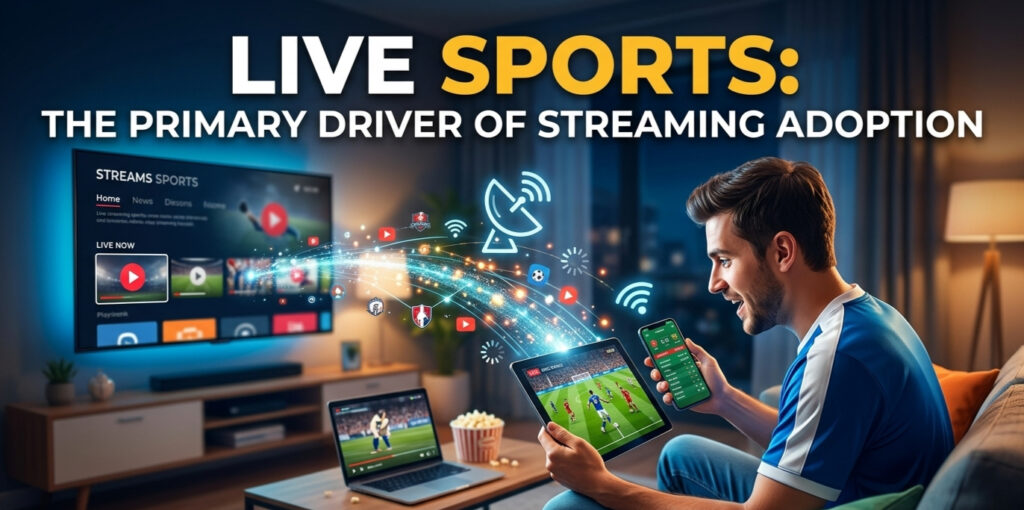
If there’s one force that’s truly accelerating the shift away from traditional cable, it’s live sports. No other content category creates the same urgency, emotional investment, or willingness to pay.
The numbers back this up decisively. The 2024 Paris Olympics shattered digital viewership records, with streaming platforms reporting unprecedented concurrent viewers — a clear signal that sports audiences have embraced internet-based delivery without hesitation.
FIFA tournaments have followed a similar trajectory, with streaming audiences growing each cycle.
Exclusive rights deals are the real disruptor. When major broadcasters lock up streaming-only rights to NFL playoff games or Premier League matches, fans aren’t given a choice — they either subscribe or miss out.
This has been one of the most effective forces in pulling even the most reluctant cord-cutters off cable.
Services competing in this space, including DirecTV Streaming, have responded by building robust sports packages specifically to retain subscribers who would otherwise abandon ship.
The technical stakes are also higher for sports than any other content type. Low-latency streaming isn’t a luxury during live events — it’s a requirement.
A 30-second delay during a game-winning play, while your neighbor cheers next door, is the kind of experience that drives cancellations fast.
Meanwhile, local channels — ABC, CBS, and NBC — remain consistently among the most searched features for any live TV service. Why? Because these networks carry NFL games, March Madness, and local news.
Any streaming package that drops local affiliates immediately loses relevance for a massive segment of viewers.
This sports-driven demand is creating enormous commercial momentum — momentum that’s opening up entirely new business opportunities in the streaming ecosystem.
The $329 Billion Opportunity | The Rise of IPTV and Reselling
The live TV streaming conversation doesn’t end with consumers. Behind every subscription sits a rapidly expanding industry reshaping how video content reaches households worldwide.
The global IPTV market is projected to grow at a compound annual growth rate (CAGR) of 16.4% through 2035, ultimately representing a $329 billion opportunity.
That’s not a niche trend — that’s a fundamental restructuring of the television business.
VOD and Internet-Based TV Are Rewriting Business Models
Traditional broadcasting required enormous infrastructure investment. Internet-based delivery flips that equation. Video-on-demand (VOD) platforms and streaming services with live TV now operate on scalable cloud infrastructure, dramatically lowering the cost of entry for new market participants.
What typically happens is that smaller operators, previously priced out of the broadcast space, can now deliver competitive channel bundles without owning a single antenna tower.
5G Is the Next Expansion Engine
5G connectivity is accelerating this growth globally, particularly in regions where fixed broadband infrastructure remains limited.
As 5G networks expand, reliable high-definition streaming becomes viable for millions of new households, broadening the addressable market considerably.
The White-Label and Reseller Wave
Entrepreneurs are taking notice. White-label IPTV platforms allow resellers to package and distribute streaming content under their own branding, creating recurring revenue models without building proprietary technology from scratch.
It’s a legitimate business entry point that mirrors the economics of SaaS reselling.
The scale of this market shift raises an important question for individual consumers: with so many providers competing for your subscription dollar, how do you actually pick the right one? That’s exactly what the next section addresses.
How to Choose: A 2026 Buyer’s Checklist

Navigating the best live TV streaming services of 2026 doesn’t have to feel overwhelming. A few focused questions will cut through the noise and point you toward the right fit.
Run your speed test first. Streaming live sports and news in 4K requires a minimum of 25 Mbps per simultaneous stream. If two people in your household watch at the same time, you need at least 50 Mbps sustained — not just peak — to avoid buffering during critical moments.
Check local channel availability by zip code. ABC, NBC, CBS, and Fox coverage varies significantly by market. Every major platform offers a zip code lookup tool before you commit.
Don’t skip this step — local news and network sports rights make or break many subscriptions.
Audit DVR storage and stream limits. Some services cap cloud DVR at 50 hours; others offer unlimited. Simultaneous stream counts range from two to unlimited, depending on your tier.
Match these numbers to your actual household, not the promotional default.
Use the free trial strategically. Most platforms offer 5–7 day trials. Stagger them — test one service, cancel, then try another — so you’re never paying for overlap.
The cord-cutting era is no longer a trend. It’s the default. The right streaming service is the one that fits your channels, your home network, and your budget — and now you have the checklist to find it.
Key Takeaways
- Cost pressure: The average cable bill now exceeds $100/month, while streaming alternatives often deliver comparable channel lineups for significantly less.
- Flexibility: Month-to-month contracts replaced the dreaded two-year lock-in.
- Behavioral change: Viewers no longer “channel surf” passively — they expect to stream live TV channels on their terms, across any screen, anywhere.
- 2026 represents a genuine tipping point
- Your streaming device shapes the entire experience.